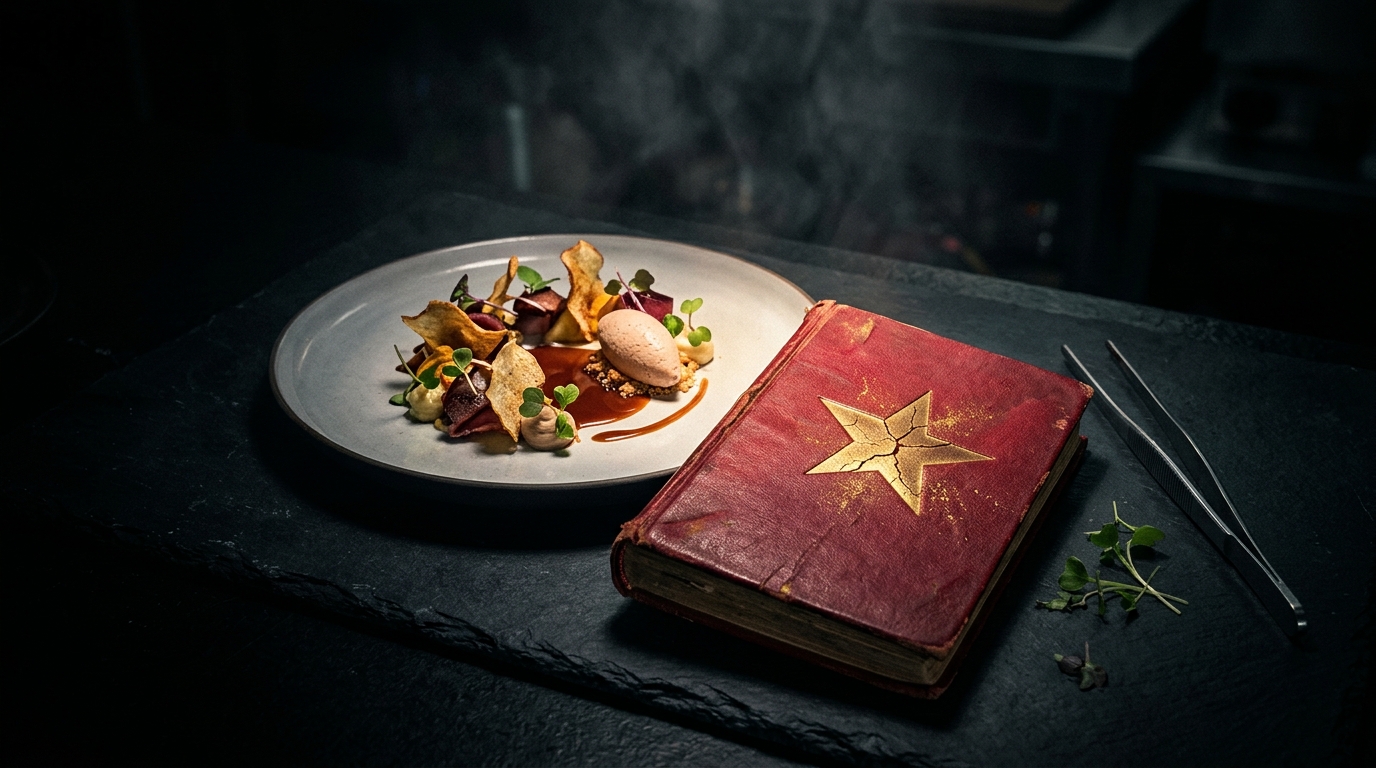
For more than a century, the global culinary industry has bowed to a little red book published by a French tire manufacturer. Chefs have wept over its stars, investors have mortgaged their restaurants chasing them, and diners have shelled out $600 a head under the spell of its supposed infallibility.
Yet behind the velvet curtains and polished silver cloches lies an inconvenient reality that fine dining insiders speak of only in hushed tones: The Michelin Guide is not an impartial beacon of culinary excellence. It is an opaque, commercially entangled, and fundamentally outdated marketing engine.
1. The Multi-Million-Dollar “Pay-to-Play” Tollbooth
Once upon a time, Michelin cultivated the romantic myth that a shadowy corps of incorruptible gourmands roamed the earth solely for the love of culinary art, funded modestly by book sales.
When digital media decimated print revenues, Michelin abandoned the pretense of disinterested philanthropy. Today, cities don’t earn a Michelin Guide through culinary greatness alone—they buy it with public taxpayer funds.
- The Florida Subsidies: Between 2021 and 2022, tourism boards in Florida—including Visit Florida, Visit Orlando, and Visit Tampa—funneled an estimated $1.5 million in public funds to Michelin just to bring inspectors to the state.
- California: Visit California handed over $600,000 in municipal money to secure statewide coverage.
- Global Payola: From Toronto and Atlanta to Texas, South Korea, and Dubai, municipal authorities write multi-million-dollar checks from civic coffers so Michelin can validate dining rooms that were already thriving without them.
If a vibrant culinary region refuses to pay the toll, Michelin simply ignores it. That is not critical gastronomy; that is sponsored municipal tourism masquerading as objective critique.
2. The Ghost Inspector Scandal: Pascal Rémy’s Whistleblower Leak
What about the legendary “army” of meticulous, globe-trotting inspectors?
In 2004, veteran inspector Pascal Rémy blew the whistle in his explosive memoir, L’Inspecteur se met à table (The Inspector Sits at the Table). Rémy revealed that Michelin’s “army” was closer to a skeleton crew: a mere five to eleven active inspectors covering the entire gastronomy capital of France.
Even more damning, Rémy exposed that sacred three-star institutions were often left uninspected for two, three, or even four consecutive years. Stars were simply grandfathered in on autopilot out of fear of public backlash and political retribution from celebrity chefs.
3. “Cheddargate” and the Absence of Scientific Standard
When legendary French chef Marc Veyrat (La Maison des Bois) had his third star stripped in 2019, he demanded to know why. An inspector claimed Veyrat had committed the culinary sin of putting English Cheddar into an alpine soufflé.
In reality, Veyrat had used saffron—infusing local Reblochon and Beaufort cheeses with a yellow hue.
When Veyrat sued Michelin in French court, demanding to see inspection receipts, notes, and evidence that an inspector had even tasted the dish, Michelin hid behind “inspector confidentiality” and claimed its ratings were protected under “freedom of opinion.” In legal terms, Michelin admitted the quiet part out loud: their stars are unaccountable personal opinions, immune to peer review or factual verification.
4. The Human Cost: The Deadliest Star
The human cost of this arbitrary theater has been devastating across generations of culinary pioneers.
In 2003, three-star French master Bernard Loiseau took his own life following rumors that Michelin was preparing to strip his third star. It was British iconoclast Marco Pierre White who famously became the youngest chef in history to win three stars, only to return them in 1999:
“I was being judged by people who had less knowledge than me, so what was it truly worth? I gave Michelin inspectors too much respect, and I belittled myself.”
From Sébastien Bras pleading with Michelin to remove his three-star restaurant Le Suquet from the guide, to chef Skye Gyngell calling the star a “curse” that replaced passionate food lovers with entitled status-seekers demanding white tablecloths, the best culinary minds have long recognized the golden cage Michelin built for them.
5. Plating Theater vs. The Walk-In Fridge: The NYC Health Reality
Nowhere is Michelin’s blind spot more glaring than in New York City.
Michelin judges tweezers, foam, caviar presentation, and the synchronized pouring of jus. They do not, however, inspect the walk-in refrigerator, probe core meat temperatures, or examine pest control logs.
In 2014, Thomas Keller’s three-Michelin-starred temple Per Se—where tasting menus soared north of $350—was slapped with a staggering 42 violation points during a routine unannounced NYC Department of Health (DOHMH) inspection. The infractions included potentially hazardous foods held at unsafe temperatures, hygiene violations, and facility issues, initially plunging one of the most celebrated dining rooms on Earth into a provisional Grade C standing.
While Michelin showered stars on dining rooms charging rent-equivalent prices, municipal inspectors found sanitation realities that would shutter a neighborhood diner.
Meanwhile, in Queens, Brooklyn, and the Bronx, immigrant families, second-generation pitmasters, and master pizzaiolos run spotless kitchens with flawless Grade A standings year after year—serving soul-stirring food that represents the real heartbeat of New York—completely invisible to tire executives from Clermont-Ferrand.
The 2026 Verdict: Real Food, Real Trust
The era of a solitary European tire company dictating what New York, London, or Tokyo should eat is coming to a close.
In 2026, true culinary prestige is not measured by whether a dining room possesses linen napkins and pays reverence to 19th-century French technique. It is measured by kitchen discipline, verified sanitary excellence, diner acclaim, and cultural authenticity.
New York dining doesn’t need a tire company’s validation. It never did.

Leave a Comment